
Michael’s Untold Story: The Shocking Price Behind the Fans’ Favorite Narrative Revealed
What exactly do we want when we sit down to watch a biopic about a pop icon? Is it a deep dive into the psyche of a genius, a raw, unvarnished life story, or just a chance to sing along to the soundtrack of our lives? For decades, these cinematic portrayals have swung between heartfelt homage and strategic marketing ploys. With the massive financial triumph of films like Bohemian Rhapsody, it’s clear the spotlight often shines brightest on promoting the artist’s hits and securing their legacy for new ears—not necessarily unmasking the messy truths behind the fame. Enter the new Michael Jackson biopic, Michael. It’s a glitzy tribute packed with dazzling performances and iconic music but notably sidesteps the darker chapters that shadow the artist’s history. So, how honest can a pop star’s story be when the story itself is curated like a greatest hits album? That question looms large here—and how you feel about that omission might just change the way you see the movie… and maybe even the man. LEARN MORE
 7 min read
What do we want from biopics about pop stars?
Are we looking for a thorough and thoughtful retelling of the life of an important historical figure? A psychological examination of a creative force? Or do we just crave a celebration of music that we love and an opportunity to revel in songs that may have changed our lives?
For more than seventy years (back to at least 1954’s The Glenn Miller Story) and throughout the recent explosion in the genre’s popularity, there are plenty of examples of all of these approaches. Increasingly, though, it’s clear what the top priority is for the parties involved in approving and assembling these stories, especially since the record-breaking billion-dollar box office attained by 2018’s Bohemian Rhapsody—a successful biopic is a perfect mechanism for promoting an artist’s catalog and helping lock down their legacy, especially with newer, younger fans.
Streaming has made all music available all the time, and almost all pop superstars (at least those of a certain age) have sold some combination of their music publishing, recordings, and rights to companies who specialize in exploiting that material for future profit. These entities need to keep breathing new life and continued interest into the work of musicians nearing the end of their careers, or even gone for many years. And the estates of the subjects need to be kept happy with how their famous family member is presented, or they’ll yank the rights to the music or image.
Which brings us to the curious case of Michael, the long-awaited Michael Jackson biopic opening this week—a project which represents the apotheosis of biopic-as-marketing device. Jackson was, of course, not just one of the greatest performers of all time, he was also one of the most complicated figures in American culture. He was driven and disciplined, obsessed by fame and success, a child star who never had a childhood, a Rorschach test for issues around race and sexuality, a talent beyond compare. He was also repeatedly accused of sexually abusing children and committing unforgivable crimes.
Michael the film does not mention that final point. The allegations and trials that defined the final decades of Jackson’s life, and for many remain an inextricable piece of his legacy, are nowhere to be found. And how you feel about the movie—and about the purpose of biopics in general—is likely to come down to that absence.
As the story goes, a version of the film was shot that was much longer and more comprehensive and did delve into the abuse scandals. But then the Jackson estate realized that Michael’s settlement with Jordan Chandler, his first accuser, required that neither side ever speak about the situation, and so that footage was deemed unusable. They decided that instead Michael would (conveniently) conclude with the world-conquering triumph of Thriller, and that the remaining material could potentially be used in a sequel that addressed MJ’s later career.
Not that this solved everything, even internally: a look at the Executive Producer credits reveals that some of Michael’s children and siblings chose to approve and participate while others did not (sons Prince and Bigi and sister LaToya yes, daughter Paris and other sister Janet no, and those who opted out have been outspoken about their concerns).
What remains, then, is a total and unabashed tribute to the rise and rise of Michael Jackson, a singer who had four straight Number One singles as a pre-teen fronting the Jackson 5 and then somehow only got bigger. The closing scene is a lengthy restaging of Jackson singing “Bad” at Wembley Stadium while fainting and screaming fans are hoisted over the barricades. This particular choice is actually a bit of a letdown as a finale (at least Bohemian Rhapsody ended with Queen’s miraculous Live Aid performance and everyone walked away on a high), but if by some chance you don’t know what the future holds, you would think the rest of his career must have been great. It’s a bit like ending the Bill Cosby Story at the peak of The Cosby Show or concluding Jeffrey Epstein’s life story while he was a promising young private school teacher.

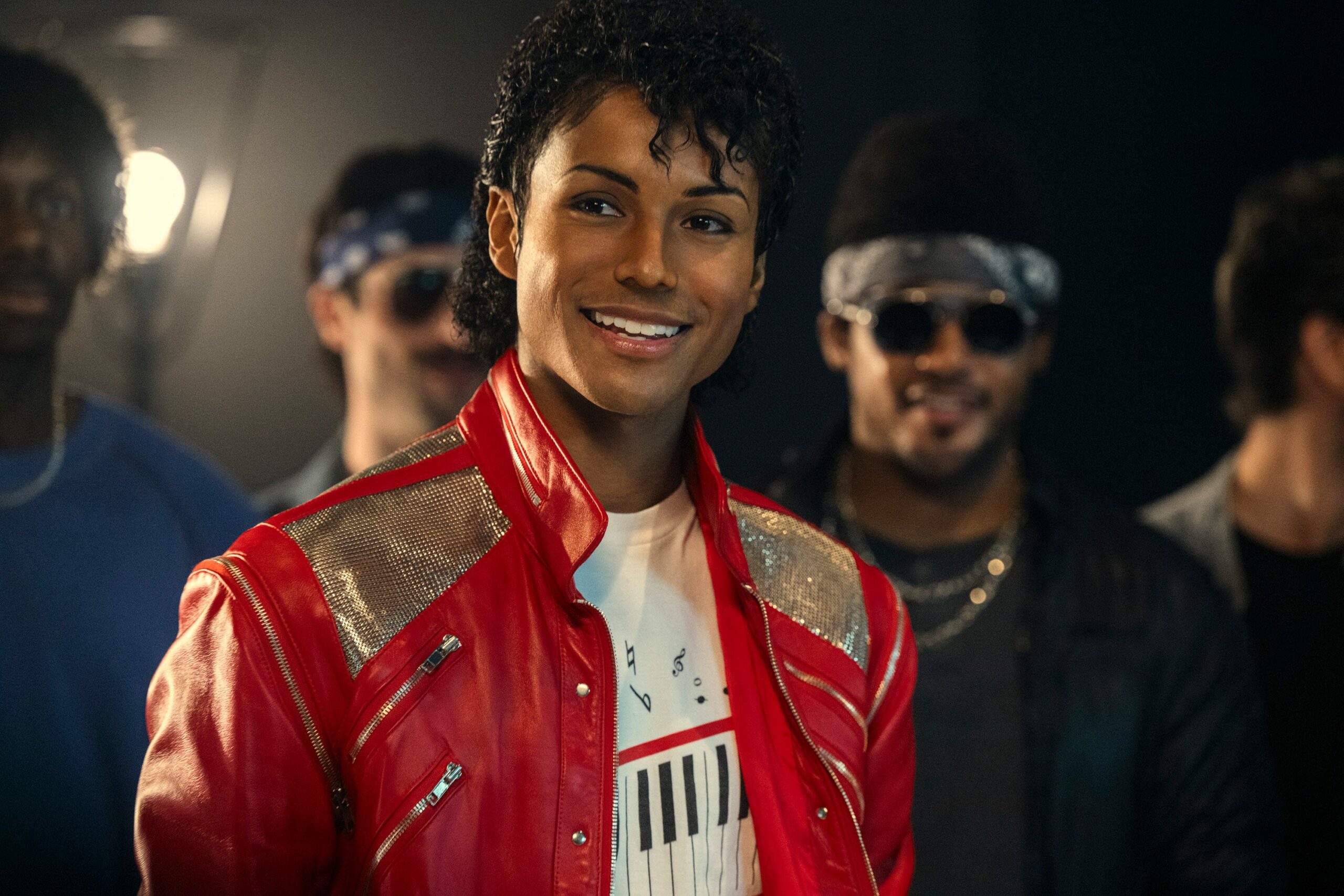
Michael Jackson’s newphew, Jaafar, as Michael.
There’s not a lot of acting in Michael; it sometimes edges closer to a concert film, with most of the screen time taken up by scenes in the studio or on the video set, followed by a montage of more and more fans going wild for the latest single, culminating on stage, often with extended, nearly full-length versions of songs. (The vocals are described as a “blend” of Jackson’s singing and the actors’ voices.)
Michael’s nephew Jaafar (Jermaine’s son) does an impressive MJ impersonation, nailing the footwork and vocal tics if ultimately, inevitably unable to fully capture the ineffable magic of a Michael Jackson performance. The real find here is 12-year-old Juliano Valdi, who was 9 when filming started, as the young Michael. He executes those Jackson 5 moments beautifully but also conveys the sense of a preternaturally gifted kid both coming into his own artistically and sensing the cost, the humanity that he is being forced to surrender.
The conflict and tension in Michael—the sole reason for his drive, his insecurity, and his downfall—all derive from a single source, his taskmaster father Joseph, played by Colman Domingo. It’s well-documented that Joseph was relentless, brutal, and likely abusive in the way he conceived and shaped his sons into a family band; in the film, his father’s words serve as breadcrumbs pointing the way toward Michael’s later problems. “In this life, you’re either a winner or a loser”—ah, that’s why he was so obsessed with charts and sales! At one point, Joseph calls Michael “big nose,” and we all know where that ultimately led. Joseph’s part is written, maybe appropriately, to be a monster, but Domingo brings enough nuance that we get a sense that somewhere underneath the rage is a man who does also care about improving his family’s lot and getting them out of blue-collar Gary, Indiana.

Colman Domingo as Michael’s father, Joseph.
Michael’s dramatic struggle is for Jackson to break free of Joseph’s control and make the music that he really wants to make. His champion in this effort is entertainment lawyer John Branca, who now happens to be co-executor of the Jackson estate. Wait, a lawyer is the hero? Miles Teller’s performance in the role isn’t helped by stilted lines like “I suggest you start laying down some killer demos.”
And what is this music that Michael isn’t being allowed to make, anyway? We never get a sense of him beyond his isolation, reading and re-reading Peter Pan, surrounding himself with animals (“They’re not pets, they’re my friends!”), watching Three Stooges and Charlie Chaplin movies, studying James Brown and Gene Kelly’s dance moves. We see the grown-up MJ interacting with children in hospitals and toy stores, but he’s purely a saintly presence—any other interior life or stifled creativity remains a mystery. And you could argue that, with the narrative we’re given, after Michael asserts his independence by cutting short the Jacksons’ 1984’s Victory tour, that’s when his troubles really began.
The timeline occasionally gets a little wonky, but the Michael Jackson 101 history lesson as presented is generally accurate, as far as it goes. The thin backstory, though, is mostly just scaffolding for the iconic set pieces we’re all waiting for: the Jackson 5 singing “I’ll Be There,” Michael recording the transcendent “Don’t Stop ‘Til You Get Enough,” the “Beat It” video, the Motown 25 performance of “Billie Jean” that introduced the moonwalk and altered galaxies. And obviously that’s the focus; these moments were masterworks that changed the culture.
In Michael, some of these reenactments soar and some feel flat. But this is also where I feel unqualified to speak, because watching a media screening doesn’t reveal the full story. In a room full of Michael Jackson fans, the sheer joy of his greatest hits will likely turn movie theaters into communal dance floors and singalongs, and that’s where the audience for Michael will click or flop. I confess that I totally missed this aspect of Bohemian Rhapsody—in a quiet, sparse showing for press, the film felt superficial and almost silly; in front of Freddie Mercury enthusiasts (and who isn’t?), it took on a bigger and joyous life. And then folks went home and streamed those songs and watched those videos and kept the revenue rolling—a game-changing win all around.
Does Michael have a responsibility to at least hint at what subsequently happened to Michael Jackson’s life and career? Of course not—it’s not a documentary, and its only obligation is to be the best movie it can be. Nor does a biopic need to be a comprehensive life story, as we’ve seen in the recent Bob Dylan and Bruce Springsteen films focusing on one period in their careers.
Any good movie, though, does require a sense of honesty, and while Michael Jackson was certainly a victim who channeled his pain into glorious work, ignoring the tougher, destructive results of that pain is ultimately deceitful.
Before the credits roll, a card fills the screen that reads “The Story Continues,” and the producers have left open the door for a sequel. But it’s impossible to imagine that film ever getting made—it would be a litany of allegations and courtrooms, declining record sales, increasing megalomania, and drug dependency, culminating in Jackson’s shocking but not surprising death in 2009. And who wants that? A real, insightful examination of Michael Jackson’s tragic life could fill ten movies, but fans would resist it and it’s damn sure not going to sell any records.
I have no idea what Gens Z and Alpha make of Michael Jackson. “Thriller” is a Halloween staple, competing with “Monster Mash” for prime holiday rotation. His streaming numbers remain strong—he’s one of the Spotify’s Top 30 most-followed artists, miles ahead of Madonna, Prince, and Bruce Springsteen, his top competition in the ‘80s. MJ: The Musical is one of Broadway’s very few breakout hits in recent years. And he’s topped the Forbes list of “highest-earning dead celebrities” for most of the past 15 years. And yet, younger generations have been raised to believe accusers even as high-profile allegations have become commonplace. In 2026, crimes and incidents charged against celebrities and politicians arrive constantly; when the first accusations were made against Jackson in 1993, it was truly, almost out-of-this-world shocking.
Michael has nothing to say about any of this. The movie is not a lie, and it’s not the truth. Each of us has to decide for ourselves if that’s good enough.
Diet Coke Soda Soft Drink Cans, 12 fl oz, 12 Pack | No sugar, no calories, 46 mg caffeine per can
$7.68 (as of October 9, 2026 03:08 GMT +00:00 - More infoProduct prices and availability are accurate as of the date/time indicated and are subject to change. Any price and availability information displayed on [relevant Amazon Site(s), as applicable] at the time of purchase will apply to the purchase of this product.)
Nespresso Vertuo, Barista Flavored Pack, Medium Roast, 30-Count Coffee Pods | Medium-Roast Coffee Capsules, Caramel, roasted hazelnut and sweet vanilla flavors
$42.00 (as of October 9, 2026 03:08 GMT +00:00 - More infoProduct prices and availability are accurate as of the date/time indicated and are subject to change. Any price and availability information displayed on [relevant Amazon Site(s), as applicable] at the time of purchase will apply to the purchase of this product.)
Lavazza Super Crema Whole Bean Coffee, Medium Espresso Roast, Arabica and Robusta Blend, 22 oz Bag
$16.73 (as of October 9, 2026 03:08 GMT +00:00 - More infoProduct prices and availability are accurate as of the date/time indicated and are subject to change. Any price and availability information displayed on [relevant Amazon Site(s), as applicable] at the time of purchase will apply to the purchase of this product.)
Amazon Echo Show 11 (newest model), Vibrant Full-HD 11" display with more viewing area and spatial audio, Designed for Alexa+, Graphite
$249.99 (as of October 9, 2026 03:11 GMT +00:00 - More infoProduct prices and availability are accurate as of the date/time indicated and are subject to change. Any price and availability information displayed on [relevant Amazon Site(s), as applicable] at the time of purchase will apply to the purchase of this product.)






Post Comment